
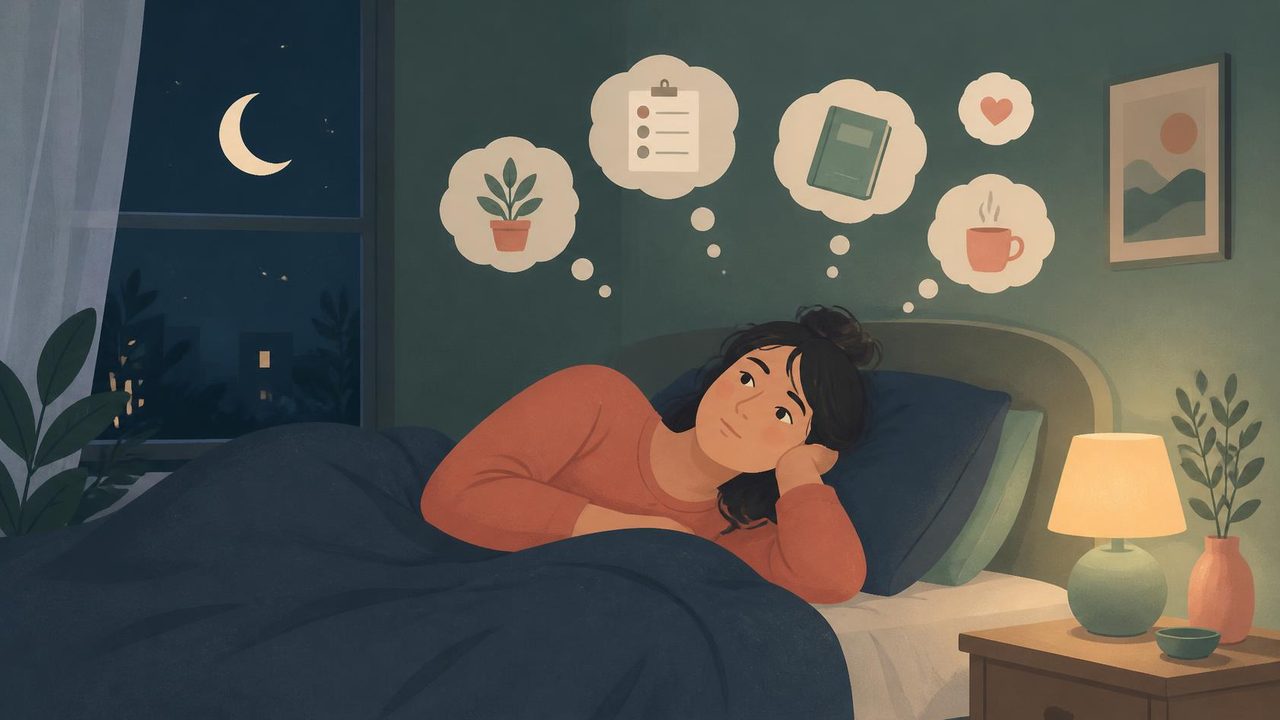
Why Sleep Is So Hard With ADHD (And It's Not a Discipline Problem)
It's 1am. You know you have an early start. You've known for hours. And yet here you are, wide awake, deep in a tab spiral, or lying in the dark while your brain replays a conversation from 2014. If that's you, we want to say this first: you are not bad at sleeping, and you are not lacking willpower. Sleep and ADHD are tangled together at a biological level, and understanding that is the first step to being kinder to yourself at bedtime.
How common is this, really?
Very. A large study published in the Journal of Attention Disorders, covered by CHADD, found that around 60% of adults with ADHD had some form of sleep disorder. Roughly 36% had delayed sleep onset, 31% had insomnia, and 29% had restless legs syndrome or periodic limb movement disorder. The NHS-linked ADHD sleep guide from Berkshire Healthcare puts the broader range of adults with sleep difficulties at 50 to 75%, and notes that sleep deprivation can be as impairing as the other adult ADHD symptoms combined.
If you have ADHD and struggle to sleep, you're in the majority, not the exception.
Why your body clock runs late
Research reviews on circadian function in ADHD have repeatedly found that many people with ADHD have a body clock that runs later than average. Your brain simply isn't releasing the 'wind down now' signals at the time the rest of the world expects. That's why you can feel sharp and alive at 11pm, and foggy and wrecked at 8am. It isn't laziness. It's timing.
The NHS guide also notes that the pattern can differ by presentation: people with more inattentive ADHD often have later bedtimes, while those with more hyperactive or impulsive traits tend to report more insomnia.
The quieter reasons bedtime goes wrong
Biology is only part of it. Bedtime is also where several ADHD patterns collide:
- Racing thoughts. With nothing else to focus on, a restless brain finally has the floor, and it uses it.
- Time blindness. 'Five more minutes' becomes an hour, and nothing in your body warns you the evening is gone.
- Transitions are hard. Stopping something engaging to start something boring (sleep) is exactly the kind of switch ADHD brains find difficult.
- Reclaiming your time. After a day of demands, late night can be the only hour that feels like yours, so you stay up for it, even when you'll pay for it tomorrow.
What can actually help
There's no single fix, and we won't pretend there is. But the NHS guide and sleep specialists suggest a few approaches that are worth experimenting with, gently and one at a time.
- Keep a regular wake time. It's the most powerful anchor for your body clock, even more than a fixed bedtime.
- Go to bed when you're actually sleepy. If you can't sleep, get up and do something calm and low-stimulation, then try again.
- Park your worries earlier. Do a short brain dump or plan tomorrow in the daytime or early evening, so your mind isn't doing it at midnight.
- Cut caffeine, nicotine, sugar and alcohol in the 4 to 6 hours before bed.
- Make your room dark and quiet, and give yourself a wind-down ritual you actually enjoy so that it doesn't feel like a chore.
Aim for 'good enough' sleep habits, not perfect ones. A routine you can keep on a bad day beats a perfect one you abandon by Wednesday.
A word on medication
Stimulant medication affects sleep differently for different people. Some find their sleep improves because their evenings feel calmer; others find it gets worse. If you take ADHD medication and your sleep has changed, it's worth talking to your prescriber about timing or alternatives. And if self-help isn't touching it, your GP or a sleep clinic can assess for things like restless legs or sleep apnoea, which are more common than many people realise. This post isn't medical advice, just a starting point for that conversation.
Be on your own side
The shame spiral at 2am, the 'why can't I just sleep like a normal person,' only makes things worse, because stress is the enemy of sleep. Your brain isn't broken. It's running on a different clock and a different set of signals. Working with it, rather than fighting it, is how things start to improve.
Make evenings easier with Focused Flow
Focused Flow is built for brains like ours: gentle reminders, easy wind-down routines, and a place to park tomorrow's to-dos so they're not circling in your head at midnight. Download Focused Flow free on iOS or Android and start building a bedtime that works with your brain.